Verbal Reasoning: Strategies to Ace your Exam
The Selective Entry Exam consists of five tests which fall into two broad categories.
Ability Tests
- Verbal Reasoning
- Numerical Reasoning
Achievement Tests
- Mathematics
- Reading Comprehension
- Writing- Persuasive or Creative
Verbal Reasoning falls under the category of Ability Tests, which measure the child’s ability to solve problems without prior knowledge. Ability generally predicts how quickly a child will be able to learn and the level of complexity they can deal with.
Verbal Reasoning is also an integral component of other competitive exams, like SEAL and Scholarship exams.
Verbal Reasoning can be challenging, but it is also one of the high-scoring areas like Mathematics.
This is a multiple-choice test that measures the ability to think and reason using words and language. Items in the test tap into vocabulary, word relationships, classification and deduction. The exam requires student to do 60 questions in 30 minutes.
The instructions on the Selective Entry Verbal Reasoning test paper are as follows:
“When you are told to begin you will have 30 minutes to do as many questions as you can. If you don’t know the answer to a question, make a guess or come back to it later. You don’t lose marks if you get something wrong. It may be difficult to finish all the questions in the time allowed, so don’t spend too long on any one question. Try to answer as many questions as you can. If you change your mind about an answer, please erase your original answer using an eraser and colour your new answer in on the answer sheet.”
The paper setter cautions that it may be difficult to finish all the questions in the time allowed, so don’t spend too long on any one question.
Based on a careful analysis of the past test papers, the following broad categories of questions are evident:
- Synonyms
- Antonyms
- Analogies
- Spotting the odd word Idioms and phrases Word box
- One word substitution
- Phrasal verbs
- Sentence completion
- Statements and conclusions Statements and assumptions Artificial language
- Syllogisms
- Logical sequence
Some of the questions involving Statements and Conclusions, Statements and Assumptions, Logical Sequencing and Deductive Reasoning may be slightly lengthy, with multiple information strings to be read, comprehended and analysed. The paper setter may also add some extraneous information (not required for solving the question), thus increasing the “information load” and challenge.
The total time for all 60 questions is 30 minutes, which gives an average time of 30 seconds per question.
The crucial aspect is that all questions, irrespective of their complexity, carry equal marks.
Proficiency in Verbal Reasoning is the prerequisite to do well in the other two English-based exams — Reading Comprehension and Writing.
The interrelationship between the three can be explained by the following simple figure:
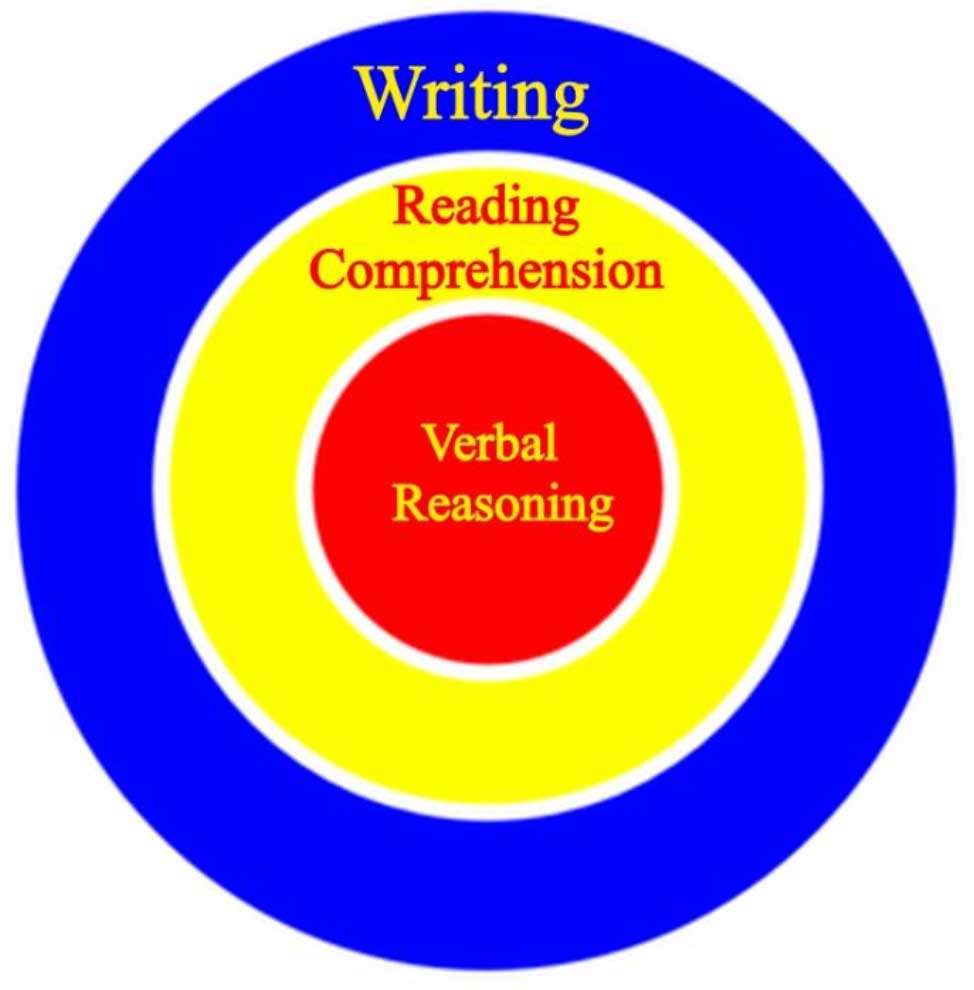
Students who are able to achieve high-level competence in Verbal Reasoning invariably do well in the other two components as well.
Building competence in this area requires sustained efforts over time.
Strategies to Develop Verbal Reasoning skills:
- Active Reading: Regular reading of quality texts of different genres.
- Maintaining a Wordbook: Note down all challenging words that you come across with their meanings, antonyms and sentence usage.
- Focussed learning word roots, phrasal words, prefixes, suffixes, idioms, proverbs.
- Revising Synonyms and Antonyms: Regular practice and using strategies like Flash Cards, Look- Say-Cover-Write-Check and a Word Wall in your study room.
- Undertake tests on Verbal Reasoning components developed by experts.
Strategies for the Exam:
Stay Calm During the Test:
Doing 60 questions in 30 minutes is a stiff target, but staying calm is crucial. Do not panic! You have already done the hard work in developing your skills over time, so this is the time to stay calm and focussed.
Straightforward questions to be attempted first:
In the first part of your attempt, please do all the questions which are less time-consuming and are straightforward. The following questions fall under this category
- Synonyms
- Antonyms
- Analogies
- Spotting the odd word
- Idioms and phrases
- One word substitution
- Phrasal verbs
- Sentence completion
These constitute the bulk of the questions and can be completed in around 20 to 22 minutes.
Deductive Reasoning Questions to be attempted in the second round:
The questions belonging to this category may be attempted letter for better efficiency and time management. The following questions belong to this category
- Statements and conclusions
- Statements and assumptions
- Artificial language
- Syllogism
- Logical sequence
The benefit of doing these questions in the second round is that you would have done bulk of the questions correctly without any stress.
Thereafter, you have only fewer questions to do which might need more time and you can focus without any stress.
Selective Omission:
Selective Omission is a strategy that is quite beneficial in all timed competitive tests. The majority of the time should be utilised to identify and solve easier questions.
Initially omit the questions which are complex, long-winded and heavily worded. You may come back to these questions later, if time permits.
Utilising Skills and Problem Solving Techniques for Deductive Reasoning questions:
- Read the question carefully. Determine what is given and what is to be found.
- Analyse the information: Break down the information into small parts. Separate the relevant from the irrelevant information.
- Synthesise the relevant information, i.e. to combine separate elements in order to form a coherent whole.
- Creating a diagram, flow charts, tree diagrams, making a table, writing the information etc. are effective strategies for analysis and synthesis.
- Eliminate the redundant answers from the given choices.
- Working backwards, guess & check are other effective strategies
There are more vital skills and problem solving techniques for such deductive reasoning questions to achieve high marks, which only an experienced teacher can share.
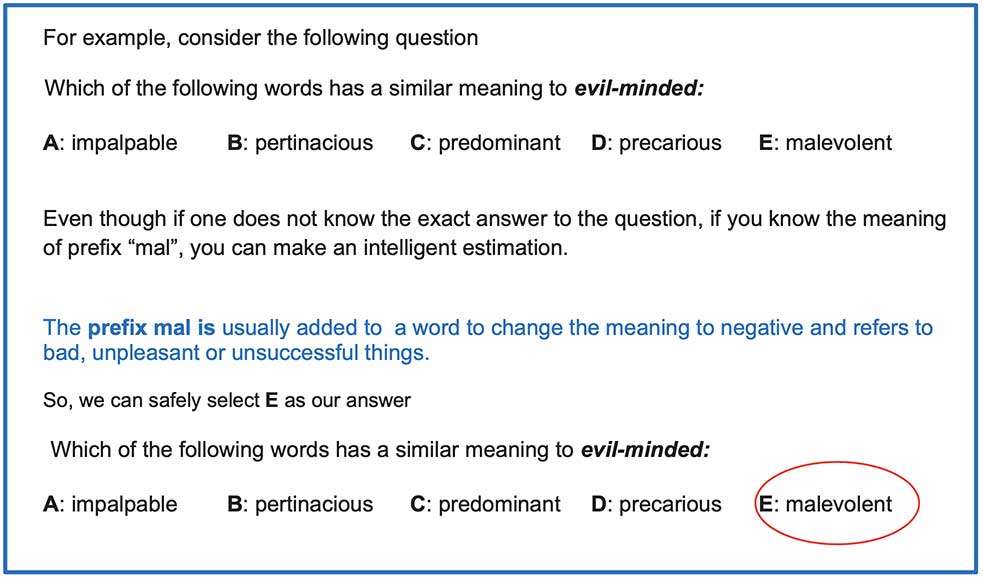
Intelligent Estimation:
This is considered a vital problem solving technique, where you can close in to the answer with elimination of other choices. Let’s say if you are not 100% sure of answer to a synonym questions from amongst the choices. In this case, you should look for some word roots, prefixes, suffixes which might take you closer to the correct response.
Attempt All Questions:
Since there is no negative marking in the test, do not leave any question unattempted. You may guess some answers towards the end, if need be. You might get some of these guesses correct.
Time Management:
As stated earlier, the total time for all 60 questions is 30 minutes, which gives an average time of 30 seconds per question. Manage time efficiently. Do your own work and do not get distracted by what others are doing.
Revise Your Answers:
Finally, if you have time, please revise your answers.

Even if you correct two of your responses, you have done a worthwhile job!
Remember, this is a competition and you need to stay ahead of others by following the best practices. It is not about how much you score; what matters is your score in comparison to other students.
It is all about competitive advantage!
Practice makes you confident and ready to take on the challenge.